
ORIGIN AND EXTENSION Surge
the decline of the Wari Empire, stretched from Tumbes to Carabaillo and covered the valleys of Moche, Chicama, Lambayeque, Pativilca Paramonga knew and Chancay.
As to the origin, the legend that their king was Tacaynamo founder, who arrived by the sea in a large pond and began construction of the great city of Chan Chan , Trujillo (La Libertad).
SOCIO-POLITICAL
The Chimu were an expansionist state centralized with clear divisions of class, inheritance of objections and a complex bureaucracy, the power was held by the great ruler named CHIMOCAPAC or CIEQUICH and Alaec, still a group with a certain prestige and economic power called Fixlla or Pillac and end were peasants, artisans and servants. This organization is Moche heritage.
economic and social system functioned through a network of rural towns that were responsible for receiving and send the taxes collected capital. The state was administered in the capital city, Chan Chan, thence management, organized and monopolized the production, storage, redistribution and consumption of goods and products.

WORSHIP
The main cult was dedicated to the moon because of its influence on plant growth, the tides and its use as a marker of time, however, each town must have their deities and local shrines. Further emphasizes the permanence of the cult of the god Sican Naylamp . The architecture has helped define the rulers lived in palaces and monumental enclosures, while the people lived in thatch houses with small rooms and outside the monumental architecture.

Chimu economy Chimu economy was characterized by the exploitation of the conquered places that pay for food, crafts, work, etc.. Forced labor specialization operation of a bartering system which allowed to obtain the products and objects that everyone did not produce. The main worship must be dedicated to the moon because of its influence on plant growth, the tides and its use as a marker of time, but each town must have their deities and local shrines. The leaders lived in palaces and monumental enclosures while the people lived in thatch houses with small rooms and outside the monumental architecture.

CERAMICS CHIMU
The Chimu ceramics fulfilled two functions, such as containers for daily use or domestic and ceremonial use pottery or burial offerings, the first was made without much finish as the funeral showed rather dedication. The main features of the Chimu vessels are a small sculpture at the junction of the neck with the bow, manufacture ceremonial pottery molded and shaped for use daily, usually metallic black coloration with some variations in brightness characteristic was obtained by steaming the vessel which had been previously polished. In small amounts are also produced light-colored pottery. In the ceramics have been translated many realistic representations as animals, fruits and characters, as well as mythological scenes.
METALLURGY CHIMU
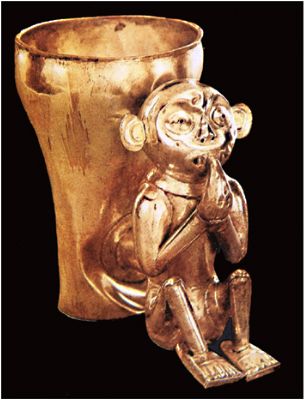
Chimu artisans worked metals in workshops divided into sections for each case of specialized treatment of metals; worked plating, gilding, printing, the lost wax casting, the pearl filigree, embossing on mold wood, etc. With all these techniques produced large numbers of objects such as cups, knives, bowls, animal figures solid or empty, bracelets, pins, crowns, etc. To make alloys used combinations of acids were naturally. Minerals must be obtained from mines open shortcut, rivers and tunnels. metals used were copper, silver, gold and tin.
HOW melting the metals?
The mined ore milled in fulling to separate them from other minerals and impurities are then fused in a kiln fuel was charcoal and mineral constantly due to fan the embers blowing them with long tubes in order to raise the temperature.

CHIMU
Textiles Spinning is the practice manual and elementary strings together a set of small to achieve a long continuous thread, in this initial work of the textiles used different instruments such as the spindle. The spindle, is a handheld wand made of a generally smaller and thinner than it thins out at both ends, it is used together with a griddle or Piruro inserted into the bottom for a counterbalance. It begins to spin around by the spinning wheel (where the fiber is set to be spun) some fibers that are fixed in the spindle that will turn quickly between thumb and forefinger cordial winding and twisting to achieve continuous fibers.
When they had obtained the necessary threads are started interbreeding bone tissue or combination of yarns to make fabrics.
The Chimu drew up fabrics, chiffon, brocade, embroidery, fabrics, double, fabric paint, etc.. Sometimes textiles were decorated with feathers and gold and silver plates, the dyes were obtained from certain plants containing tannin, and walnut molle; of ferruginous clay minerals such as aluminum and biting animals and cochineal. The garments were made from the wool of four animals, the guanaco, llama, alpaca, and vicuña and native cotton plant that grows naturally in seven different colors. The clothing of the Chimu was in loincloths, tank tops with or without fringes, small ponchos, tunics, etc.
THE SUNSET CHIMU
the mid-fifteenth century, the most powerful kingdom in the coast, was annexed by the prince to Tahuantinsuyo Inca Tupac Yupanqui (son of Pachacutec "the founder of the empire"). This during the reign of Chimocapac Caman Michan. According to the chronicles, it was very difficult to break into the realm Inca prince, by the imposing walls of Chan Chan, it is said that the capture would have occurred only chanchan after 6 long months.


